

When I close my eyes and think about last summer, I see myself lying diagonally across the back of a rented Bronco, attempting to sleep while sweating inside a too-warm sleeping bag.
It’s June in the Yukon, and the sun burns bright and long, well past any semblance of bedtime. The animals are certainly awake. I can hear bird song from the cracked windows of the car, which I’ve artfully covered with special bug nets for the occasion. It isn’t just small animals that are awake at all times; I’ve seen several clusters of black bears eating dandelions on the side of the road, a mother moose with her calf down near Carcross, and one lone grizzly, walking in the center of the road up on the Hanes Highway, far above the treeline. These larger creatures are my chief concern and the main reason why I decided to sleep in the back of an SUV rather than inside a tent. That being said, I have not seen a single bear in any of the campsites thus far; Yukoners are responsible campers and are very careful with their food.
I manage to catch a few hours of sleep, with the help of a sleep mask and some earplugs. I wake up early anyway (I’m not a morning person, but the sun really does mess with circadian rhythm) and head to my main destination of the day: Kluane National Park.
The drive is devastatingly beautiful, particularly the part through Destruction Bay. Sand blows along the dried river bed, gathering in wave-shaped dunes. I squint, hunched over the wheel, as the Bronco flies through sand clouds. It’s a holiday Monday in the Yukon so the tourist center is (unfortunately) closed, but I already have the trail map downloaded on my phone. I grab the tourist pamphlet just in case; there’s an emergency number listed on it to call. I laugh. There’s no service here anyway, how on earth could I call someone for help?
The hike up Sheep’s Creek, one of the main trails, is a steep one. The elevation gain is about 1100 meters. It’s one of the steepest day hikes I’ve done, but I feel ready for it; I’ve been hiking for a few weeks now. The first bit of the trail is flat and calm—until a fat pheasant explodes out of the bush in front of me, along with half a dozen chicks. They scramble across the path into the bushes, peeping, and the mother spreads its wings and rushes towards me, zigzagging along the path. I run backwards, my hiking poles flailing, until she launches herself off the ground and lands on a low branch, squawking. I slink past, looking sheepish—so much for being a bold adventurer.
The entrance of the trail is marked with a commemorative plaque.
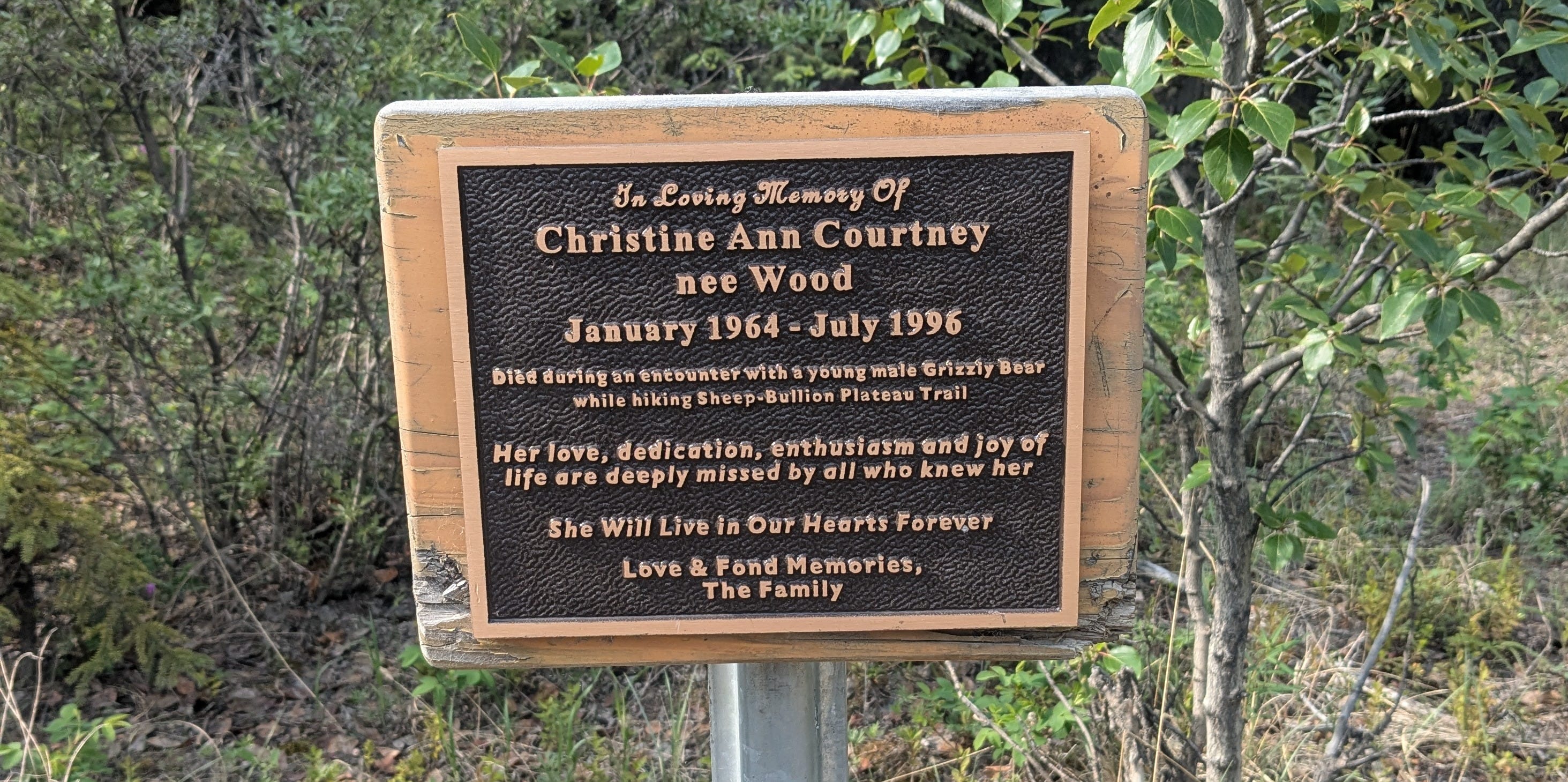
“It’s fine,” I say out loud, with false reassurance. I touch the bear spray I am carrying in the side pouch of my bag for comfort. “There will be other people on the trail. It’s a holiday!”
Sadly, this is not the case. The trail is perfectly empty—every hiker’s dream, but not mine. I sing, clap, and talk myself through the hike, and occasionally yell, “No bears allowed!” while rounding the switchbacks. I use my poles to test the scat I find to ensure it is not fresh; the Yukon is the only place I’ve hiked where I’ve had to track scat, paw, and claw marks for safety. (I know that sounds badass, but it was fairly terrifying at first.) At this point in my trip it feels almost normal. Luckily for me, there are no fresh signs of bears—or any other animals—on this hike.
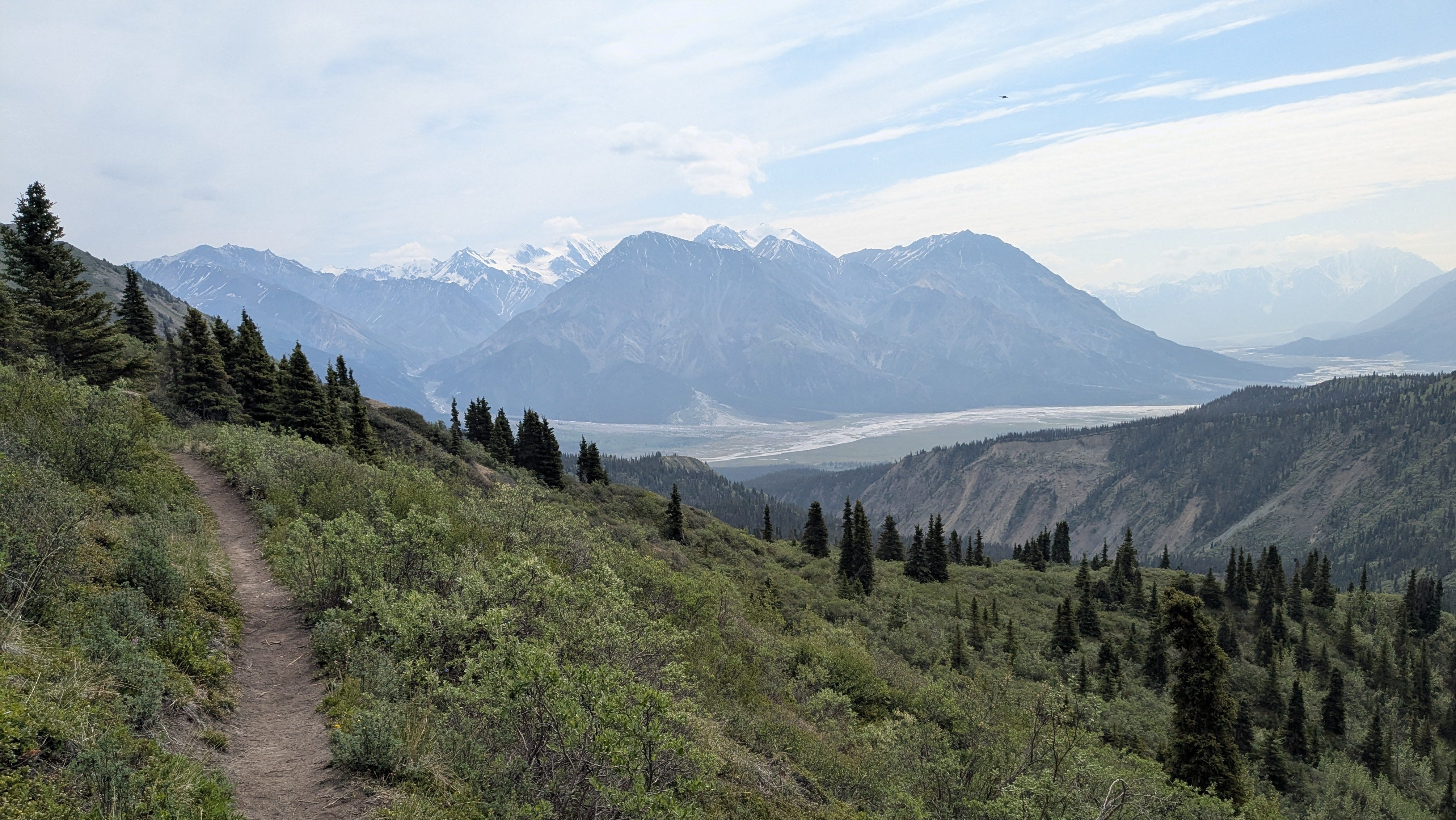
The trail is steep and mostly unshaded. The sun is scorching, even this far north; in the summertime, the Arctic is essentially a desert. I’m consuming water much faster than I had planned, even though I’m carrying roughly three and a half litres with me. I take a break at a viewpoint for an apple, which helps. The smoke from the wildfires is not so bad today, and I can see snowy peaks in the distance. Wildfires are common in this part of Canada; this far north, they are usually caused by lightning. The smoke can drift in from hours away—visibility is a game of wind direction, of chance. The threat of smoke might account for the lack of hikers on the trail.
Finally, I break above the tree line. Now that I have better visibility, I relax a little. No, I cannot outrun a bear—I’ve seen a grizzly run uphill in Glacier National Park in British Columbia, and let me tell you, there is absolutely no outrunning that thing—but at least now I can see one coming and plan for my demise. Step by step, I ascend the final part of the hike, panting. It’s so steep that I’m almost crawling up it. There are little fist-sized holes speckled along the sides of the path, and marmots—or perhaps just a single marmot—pop in and out of them as I pass, squealing in warning.
“Just passing by,” I tell them/it, doing my best not to step on their home. My feet skid and slide on the sandy slope, and I fall to my knees several times, until finally, finally, I reach the top.
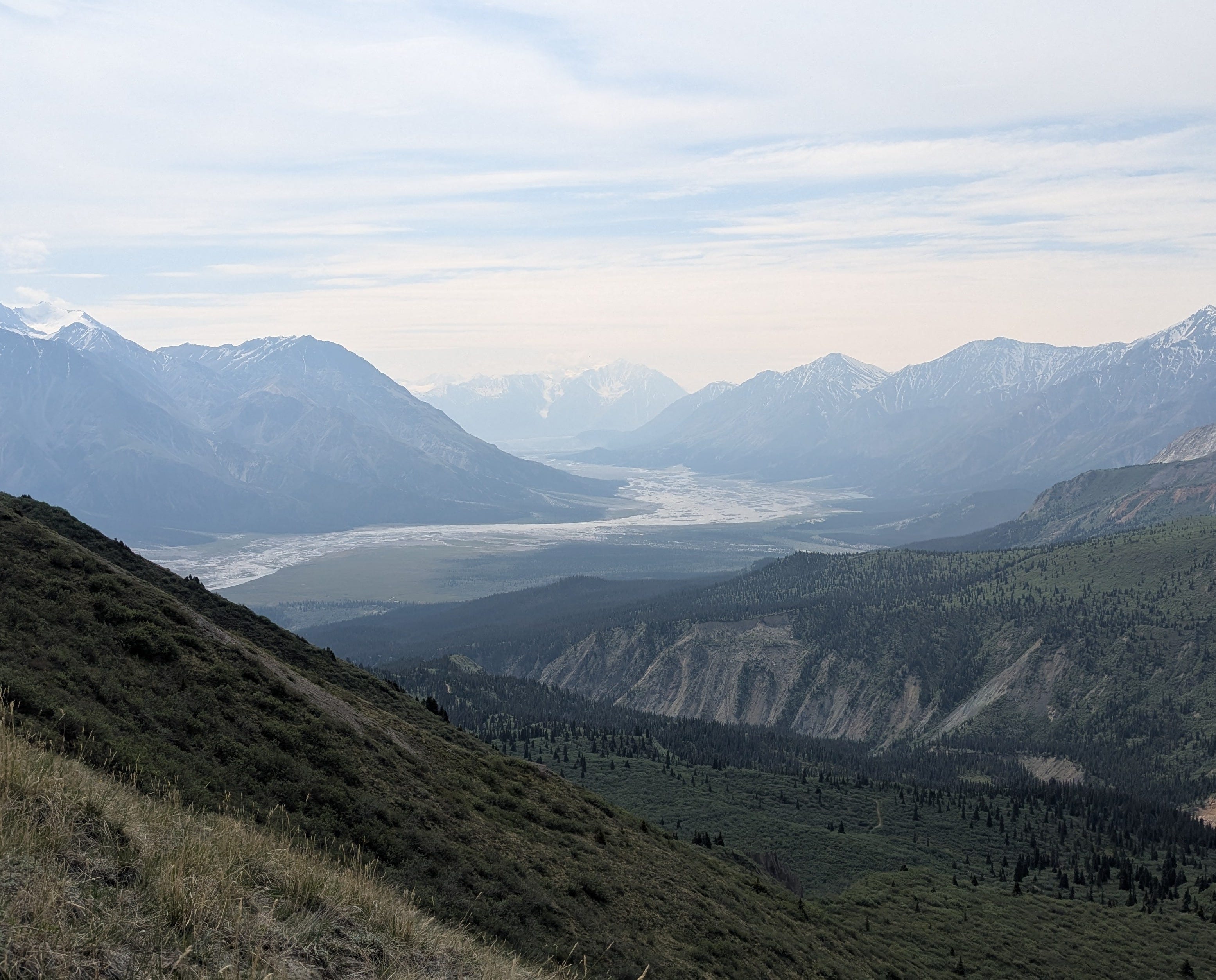
The view of Destruction Bay is breathtaking. Kaskawulsh Glacier cascades down the riverbed, hazy in the smoky conditions. Snowy peaks rise sharply above it, piercing the blue sky. Gusts of sand blow across the bay and trails of thin glacier melt wind through it, heedless of direction. The scene is framed on either side with hilly green hills, almost completely devoid of trees. I feel a pull, a longing, to hike even higher, to see even more, but the hike back would be too long, and my legs are already tired. I lie down instead, almost vertical on the slope, and bask in the warm sunshine. I spend an hour there, eating my lunch and relaxing, to the point where I almost fall asleep. The threat of bears is the only thing that keeps me awake.
In the distance, I see another lone hiker, likely climbing up for the late sunset. We wave at each other, and relief courses through me, releasing tension that I didn’t know I was carrying. Perhaps they feel as relieved as I do. Checking my phone, I realize that it is already evening. I haul myself up, ready to begin my descent. I feel an infinite sense of wonder, satisfaction, and weariness—a combination that, for me, only comes from long trails like this. I take a step, then another, tracking my own prints in the dirt. The trail snakes on and on in the distance, and the proud midnight sun shines on, relentless.