

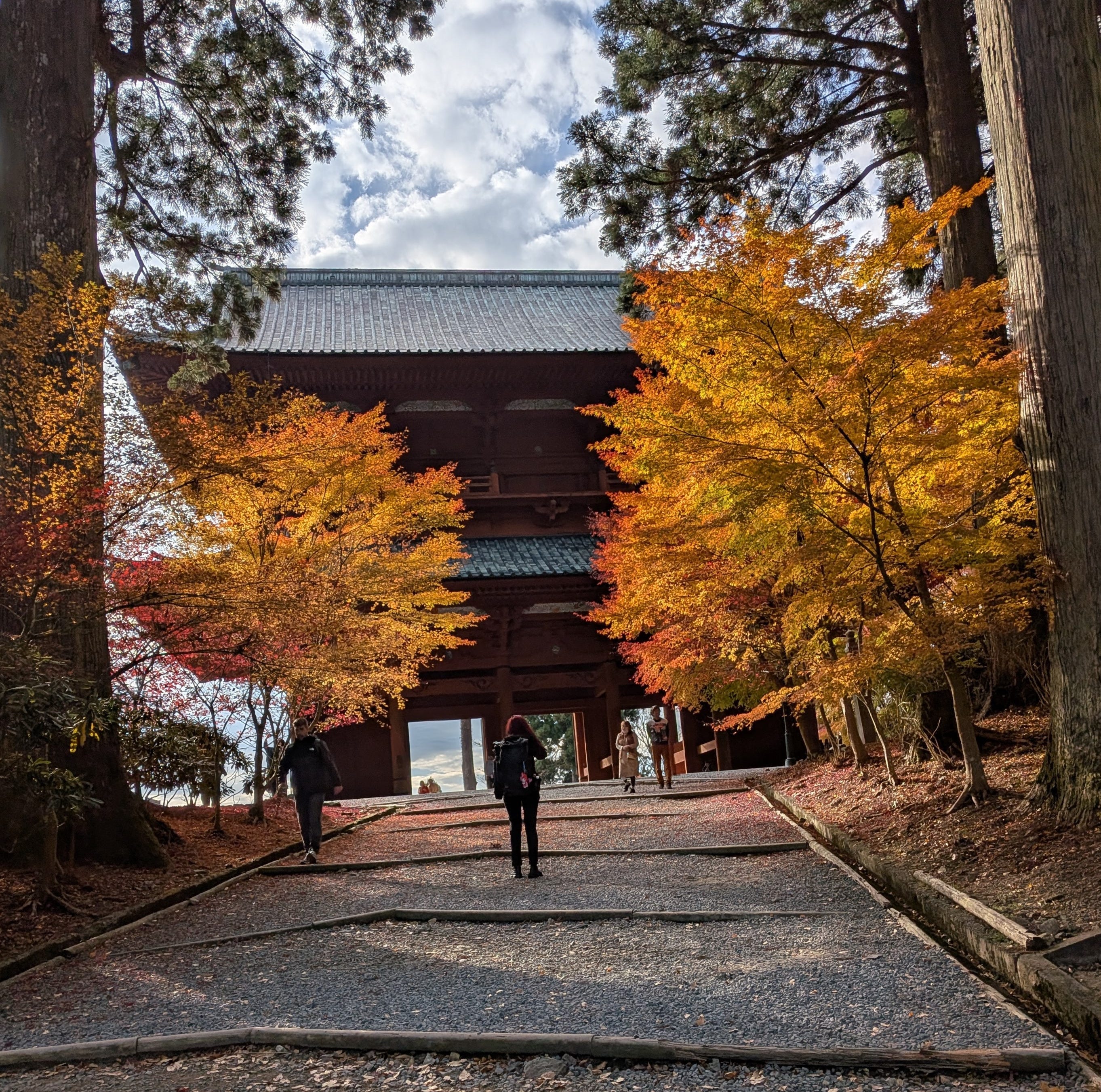
Stepping into Japan always feels like arriving on a perfectly curated planet. This is my first time here in the fall, but every visit feels more or less the same: the level of care in Japan really relaxes my mind to stillness. It’s all in the small details—in every swept pile of deep red maple leaves, in every persimmon that is hung at exact staggered intervals on a balcony. It’s in the nutty scent of a fresh cup of genmaicha tea, in the taste of chestnuts in local sweets. Still, I’m restless. There must be some facet of Japan that I have yet to experience, something completely different from day-to-day life. But what?
On the advice of a friend who had once lived here, I make my way south. I hop on and off a series of trains, a funicular, and a bus, all steadily climbing upwards, until I stand before a giant two-story red wooden gate. Two guardian statues glare down from either side, surrounded by smatterings of colorful leaves. I step over the central wooden beam, the threshold between the messy outside world and the grounds that lie within. This is Koyasan, the center of Shingon Buddhism—one of the most sacred regions in all of Japan.
I slip through town and enter the guesthouse through a sliding wooden door. It is quiet inside, and there is a faint smell of incense. I wait in a small, well-kept living room, sock-footed on the tatami floor. The owner enters through another sliding door, apologizing for the delay. He leads me upstairs to my designated room, also covered in tatami. The closet door has a painted pine tree on it, and the window is wide open. I shiver. Sunlight trickles through the bright red Japanese maple leaves outside, but the days are growing ever colder. I set up my futon bed, as is custom in most Ryokans, then shut the window. In the distance, I hear a giant bell ring.
Clouds fill the sky the next morning, threatening rain. I walk through town, which is even quieter than the day before. Rows of dark red maples line the pathways between the massive red and white Konpon Daito tower and the rest of the town. The temple is silent when I enter, though several people are already sitting in the front row. There is an empty metal firepit in the front of the room; in behind is a fierce-looking statue of yet another snarling man, carrying a sword in one hand and rope in the other. He is wreathed in red and yellow carved flames. I purchase a wooden prayer tablet from a blue-robed monk and then sit down to carefully write out my wish. The room slowly fills until we are at least thirty buzzing spectators. We are all here for the fire ceremony, but I have a feeling that none of us know exactly what to expect.
A yellow-robed monk silently enters and sits down cross-legged on a raised platform facing the pit, his back to the audience. First, he rings a bell, the sound so clear it pierces through any leftover chatter, cutting it to silence. Then, the chanting starts, a low, steady thrum. The monk lights a single piece of kindling from a nearby oil lamp; such a small flame, no more than a few inches high. Piece by piece, the monk slowly alternates adding kindling to the fire, scooping and adding oil to the flames, and waving the air brusquely with a long metal poker. He taps the poker against the sides of the firepit to create a ringing sound, a sort of punctuation, perhaps to tap out the soot. The scene is rhythmic and mesmerizing, and I feel my senses narrowing, focusing down to the monk and the flame. Outside, there is a faint sound of rain, but it sounds muted and distant, a passing thought that fades into the background. The flames grow higher and higher, until they are over the monk’s head.
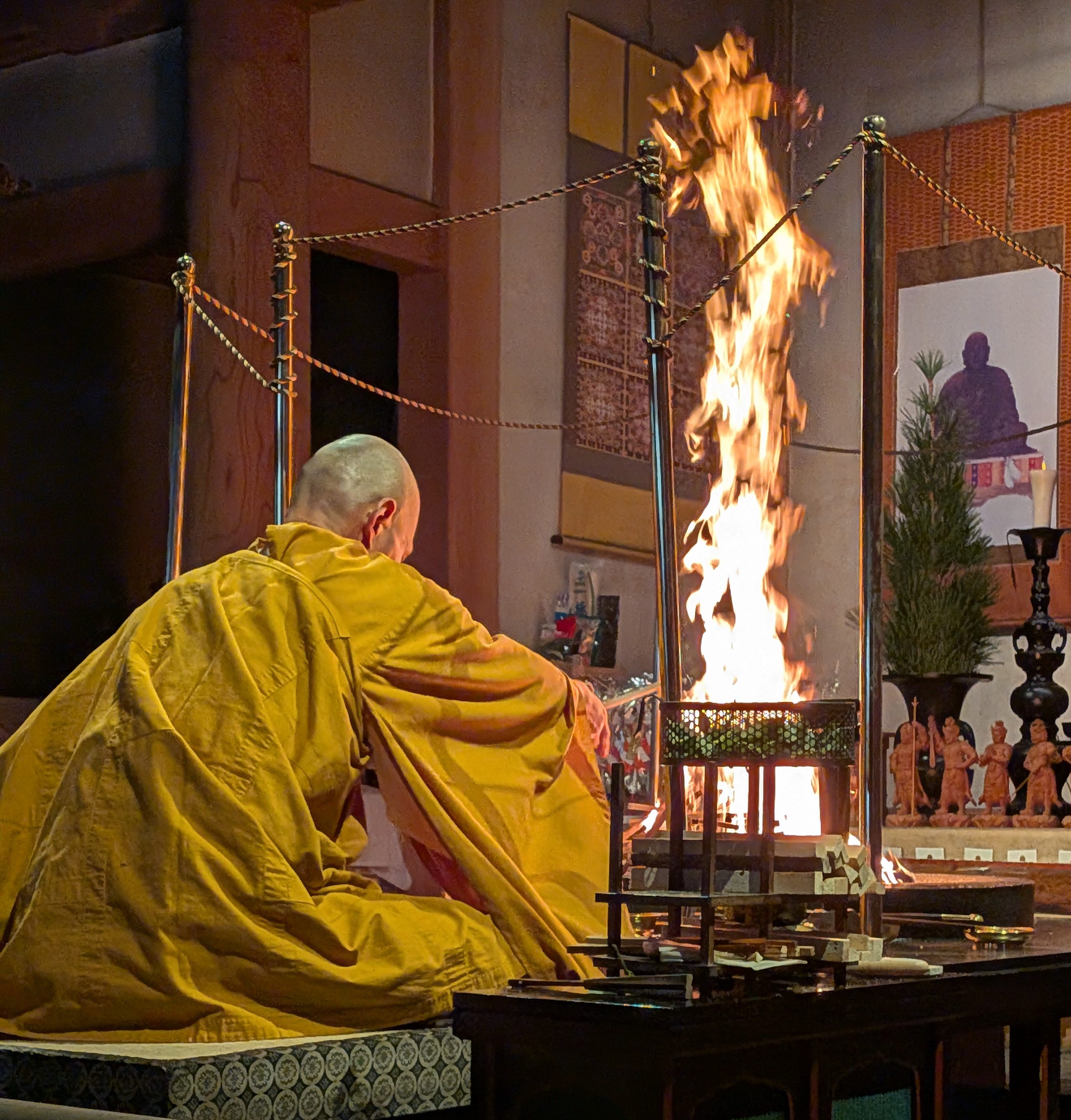
The chanting does not change, but something in the air shifts, and the guests—including myself—rise to their feet, heading to the left side of the pit like sheep. How is it that we know what to do? Two by two, we approach the fire, kneel, and toss our prayers in. The monks look on, impassive. Finally it is my turn. I hesitate, then kneel anyway. Heat blankets my face and runs its tendrils down my shoulders, so hot that it is almost unbearable. Some kind of survival instinct sharpens my focus further, until all I can see is the flame. I raise my token up to my forehead, and toss it down. It immediately catches, the flames devouring it within moments. I somehow get back to my seat, though I am not entirely sure how.
I watch on as the monk continues his endless alternations of adding oil and waving the air. The fire dips lower and lower, and I suddenly realize that I am the only person left in the room other than the monks. Why did everyone leave? Self-conscious, I creep backwards and kneel by the sliding door, unwilling to go, but equally unwilling to remain at the front alone. The flames fade, bit by bit, until there is nothing left but glowing coals. Suddenly, the chanting stops. The air empties itself for a moment. Then, the monk raises the bell high, and rings it once more. In the aftershock, he stands, and with an almost embarrassed look on his face, bows first to the monk in blue, and then to me. I incline my head slightly and then quickly let myself outside. The sharpness of the cold rain surprises me, and I scramble for my umbrella, dropping it on my hasty way out. The walk back to the guesthouse is disorienting. The bright fall colors look sharper, the rain feels colder, and at some point it even begins to hail.
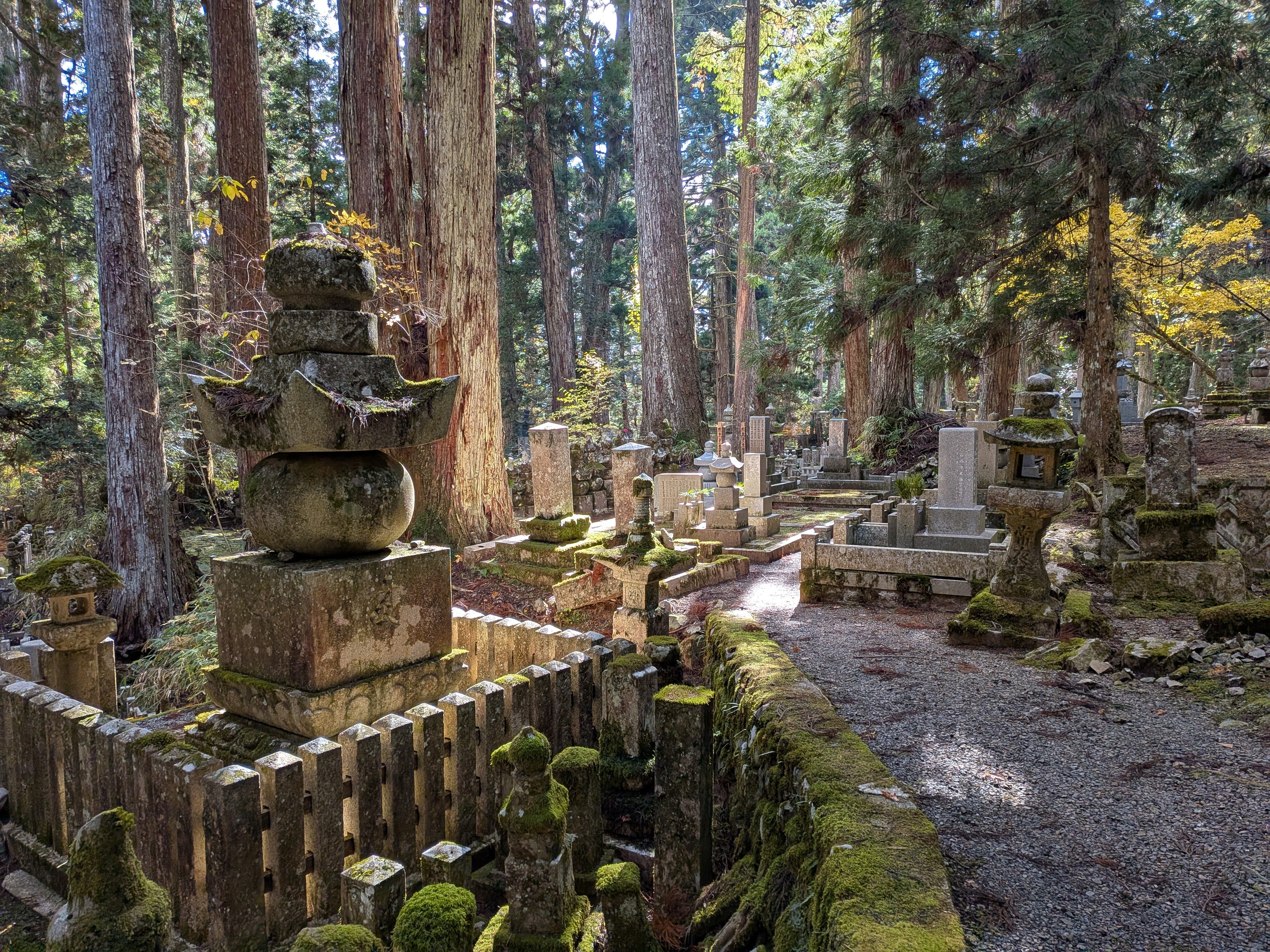
Still reeling from the fire ceremony, I take my time walking to Okunoin early the next morning. In contrast to yesterday’s experience, the monks’ graveyard is both quiet and cool. The path is lined with unlit stone lanterns. The warm morning light slants past ancient cedar trees, illuminating thousands of moss-covered gravestones and memorial markers. Among them are old Buddhist columns, made up of various geometric shapes representing earth, water, fire, and air. As I walk through the forest, more and more columns appear, some as tall as a house, others as small as a child. They cluster together and spread apart, running up and down the hills sporadically, peeking out behind rocks and trees. Statues of children sporting bright red bibs dance among them, never without a small tray of offerings. I place coins in some of them out of respect. It is a place of rest that feels both calm and chaotic all at once.
I arrive just in time for the mid-day offering ceremony. Several workers clear the way for two masked orange-robed monks bearing food inside a palanquin. They walk briskly over a small bridge and up to the inner mausoleum, where it is said that the great Kobo Dashi is still in prayer today. I follow them up to the temple, taking advantage of the dispersal of the crowd. The main temple is a loud place, full of steady chanting, the beating of drums, and the scent of incense. Absolutely no photography is allowed, and the inner mausoleum itself is not accessible to anyone. There is a temple next to it which is filled with one thousand lit lanterns. I stay there for awhile, admiring the soft flickering lights, before crossing back over the bridge, where people are throwing ladles of water on several Buddha statues of all different shapes and sizes. It is a form of prayer for deceased family members and friends. I pour water on each one until I’m standing in front of the last statue, expectant. But no, this isn’t quite it, not quite what I was searching for. I throw the last ladle full of water, offering up one last prayer. I stop for a cup of tea in the rest house, where the flame heating the kettle has been burning for over a thousand years. Then I make my way back to the guesthouse; perhaps some rest will help, and I will need my energy for later.
Places often feel so different at night, a graveyard especially so. Luckily for me, the weather stays clear and cold into the evening. I am dressed in every warm layer that I have, but the dampness permeates my clothes and makes me shiver. I stop at the Seven Eleven and line up with the monks, who seem to be purchasing a combination of snacks and dinner items. I buy a bottle of hot lemon tea from a small heated drink fridge near the cash, and take it with me as a hand-warmer. I join a small group tour, hardly listening to the short monk as he tells stories of the place in slow, careful English. I’m too absorbed in the brightness of the lanterns, the shadows of the gravestones, and the small pale clouds of exhaled breath in the cool night air.
As the tour ends, various guests are whisked away by drivers in order to make their temple curfew. The tour guide offers me a ride as well, but I decline. The hot tea is still warm in my hands. I take my time walking the lit path until I am the only one left. I am not afraid, though perhaps I should be. I turn the flashlight on my phone, and head up into the hill. I can hear the rushing water from the small waterfall under the bridge, and the lit path keeps me oriented. Perhaps it is completely disgraceful to visit the graves at night, but I feel a kind of peace come over me. As I walk between the silent pillars, the ripples of my mind smooth out into perfect, easy stillness.
Eventually I simply get too cold to stay. As I head back towards the town, I hear the sound of the curfew bell in the distance, a soft melody that plays over the town—it is only nine o’clock, and I have barely been in the graveyard alone for an hour. Everyone is already in bed for their curfew; not a soul is out on the streets. Halfway back, it begins to snow.